
Climate Stress and U.S. Dairy Production
Published:
Job market paper
Estimating the Economic Impacts of Climate Stress on U.S. Dairy Production: Evidence from Debiased Machine Learning and Simulation-Based Estimator Choice, with Mario Ortez, Bradford Mills, and Michael Cary. Draft v1.5, last updated October 19, 2026. Funded by The Dairy Alliance.
Read the paper · Abstract and citation
Main findings
An additional 24-hour-equivalent day at a temperature-humidity index (THI) of at least 69 lowers milk per cow by 0.29 percent over the exposure month and three lags. The cold estimate is −0.22 percent per day below THI 39, with a 95 percent interval that includes zero. Heat lowers milk fat content, while cold raises it.
Removing heat stress would have raised production by about 1.7 percent; removing both heat and cold would have raised it by 2.9 percent. Applying the joint share uniformly to 2003–2024 production in the 48 contiguous states gives an illustrative value of $23.9 billion, or $1.09 billion per year. These magnitudes depend on the assumed response function, which the data cannot pin down. Evidence of adaptation is suggestive and sensitive to specification.
Interactive dashboard: earlier snapshot
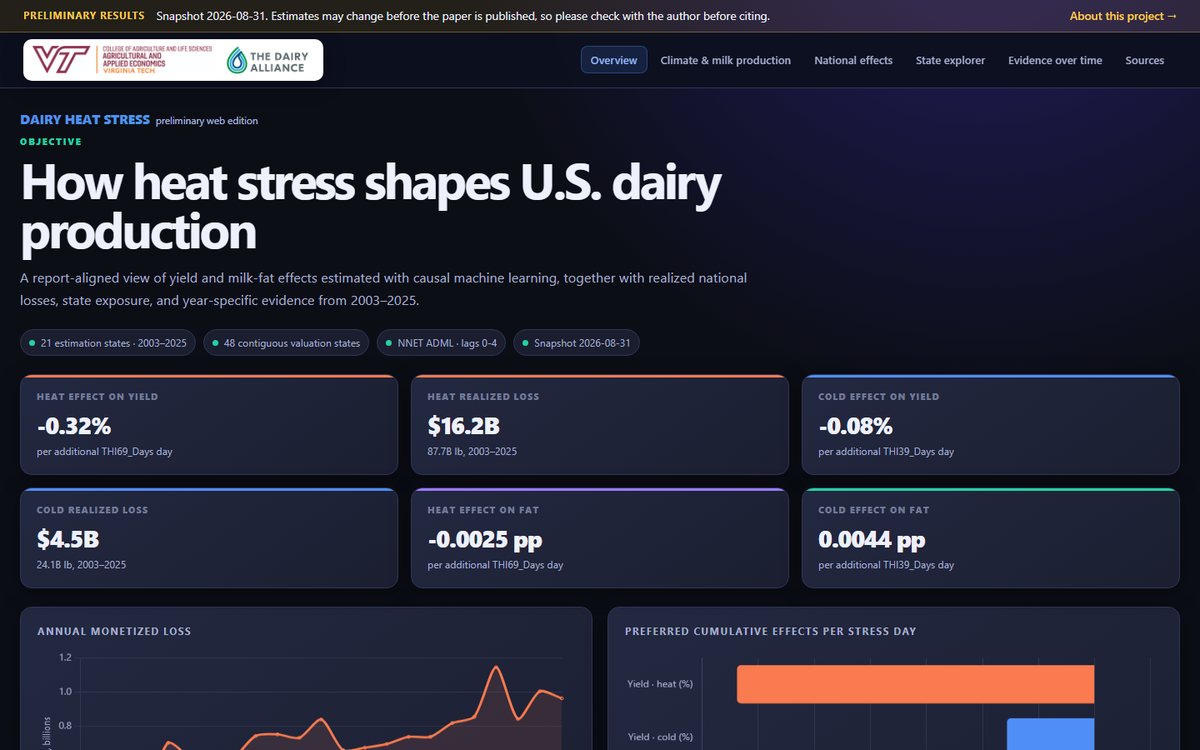
Open the interactive dashboard
The dashboard is an August 31, 2026 snapshot covering 2003–2025. It predates draft v1.5 and uses different estimator choices and valuation calculations. Its charts and dollar losses do not represent the current paper’s results. Use the paper linked above for current estimates and their limitations.
The decision
The scale and geographic distribution of climate-related production losses help inform cooling infrastructure and adaptation support. The paper estimates production responses and illustrates their economic scale; evaluating a particular investment also requires its costs and effectiveness.
Approach
USDA NASS outcomes for 21 major dairy states are matched to hourly ERA5-Land weather aggregated using county milk-cow inventory weights. State-by-calendar-month fixed effects absorb state seasonal cycles, and year-month fixed effects absorb national monthly shocks.
The analysis compares linear and cubic regressions with LASSO and neural-network learners, with and without automatic debiasing. Synthetic-data simulations guide estimator choice separately for heat and cold, selecting a cubic regression for heat and a debiased neural network for cold. Both use two-way clustered intervals. A break search finds no detectable change in yield responses, while the heat effect on fat content weakens after the mid-2010s.
Status
The current working paper is available above. The interactive dashboard remains available as an earlier snapshot and has not been rebuilt to match this draft.